By: Barbra Sue Yurachek
NO PROMPT – but a note of context from Jack: ‘INEZ’ was always known to my siblings and me, as ‘GG’
I walked into the hospital room not knowing what to expect, knowing it would be upsetting, maybe even tragic, to my daughter-eyes. My mother had become the widowed matriarch of our shrinking extended family no more than 10 years earlier when my 66-year-old father slumped in his recliner, never to take another breath. His heart had stopped short, like a car that missed a turn on a country road correcting itself. And now —a stroke, major and deadly. Her last words were, “Gordon this is the big one. I love you.”
She was expecting it. Her mother had gone this way, and her sisters, distant and recent cousins were felled by this imperfect brain glitch. My sister and I saw our future; the labored and noisy breathing that some, in earlier times, called the death rattle. We called it the death of our mother. We were about to become adult orphans—and we were not ready to say goodbye to our only real advocate and mentor in a harsh and fast-paced world. She was 72.
The date was Aug.13, 1995, the 9th wedding anniversary of her older granddaughter, and 14 days from her younger granddaughter’s 8th birthday. Hazel Inez Hazlewood was pragmatic, personable, and playful. She changed her name to Rebecca when she entered high school because she did not want to admit to “Hazel Hazlewood.” Such a name did not fit Inez’s image of herself.
Somewhere around 1945…
I was 5. She was 23. We were on the back porch of our little house on Happy Corner. A tiny house we shared with Aunt Imogene. My mom and my aunt were both war wives. My dad had just been drafted into WWII. His brother, Henry, was in a hospital in Germany (or France, I am not sure which) suffering from a broken back caused by a falling tree during a raging battle on a remote island in the Pacific. He had lied about his age, married his girlfriend, and enlisted in the U. S. Marines. He was 17 and wounded.
My mother was washing clothes in her modern Whirlpool wringer washing machine. I was playing in the yard with 4-year-old Ronnie Krall whose grandparents owned the little store next door. Ronnie’s mom Sybil was also an army wife. That was the day my mom spotted the pup. He was a stray walking on the highway. Ronnie’s grandpa rescued him from the dangerous corner that was known for many fatal accidents. In reality, our corner was not “Happy” but a death trap for many unsuspecting, speeding youth and unfamiliar adults returning from the bars at the Missouri state line.
Our state was dry and our driving age lower. The pup was warm and cuddly. After protests and his grandma’s insistence, Ronnie relented. Teddy Boy was mine. I was surprised my mom agreed. She was not a dog lover. Teddy and I were inseparable. My mom even allowed him to sleep at the foot of my bed.
Had she changed her opinion of dogs? NO. Just Teddy and swayed by the fact my daddy was far away.
The three of us and Teddy had a wonderful spring and summer. The fall arrived, and also the school bus. My aunt who had been taking education classes received her teaching certificate and was hired at the same school I was to attend. We both rode the big yellow bus to Brown Spurr Elementary school where she taught first grade. I was in what were called “Primer classes.” One day on returning from school, Aunt Imogene and I found my young mother in tears. Happy Corner had claimed another victim—Teddy Boy. My daddy was still far away, Korea, but due to be discharged after his two-year tour of duty. The war had ended while he was in mid ocean. His ship was diverted, and instead of France, he disembarked in Korea. My uncle Henry was being sent home on a medical discharge. Ronnie’s mom had sadly become a war widow some months prior. My mother was crying for many reasons that day, and as young as I was, I learned you can be happy and sad with the same tears.
Several years after the war I witnessed a fight between my parents that scared me but made me laugh, as it did my mother a couple of weeks after. One winter morning my only sister who was 11 years younger than me and at a very impressionable age (always parroting what she heard while dragging around her rag doll, Fanny, by one leg in one hand and clutching a beat-up, empty aspirin tin in in the other) came into the kitchen bright eyed and verbal from her night’s sleep. We owned a beautiful white Persian cat named Snowball. While my mom had a very strong dislike for dogs, my dad loathed and despised cats, and Snowball knew it.
Much to my mother’s chagrin, my dad referred to Snowball as “The Son-of-a-Bitch.”
My toddler sister chirped, “Good Morning Mommy, Good Morning Daddy, Good Morning Sissy, and Good Morning Son-of-a-Bitch.”
My mother’s whole demeanor turned from serene, proud mother of a darling little toddler to a loud, screeching ninja.
“Willie see what you have done!”
She had dropped her toast- her fork clanged to the floor.
“How many times have I asked you to curb profane language around the baby? If she grows up with the vocabulary of a Teamster it will be your fault!”
She storms off to her bedroom in tears. My dad picked up my sister and said,
“Babe, from now on you should call that damn son-of-a-bitch ‘Snowball’.”
My mother was a farm wife. That meant preparing very large meals at 12 noon for any man working in our fields. That noon meal was called ‘dinner’. I was a teen when I had my first lunch.
Farm women had to do their share which meant helping to chop cotton and pick it as well when my dad was short-handed. She drove a pick-up to the bean elevator where soybeans were stored in grain silos. She cleaned chicken-houses and plucked the down from angry geese. She sewed our small dresses and her own using Simplicity’s paper patterns. She helped in our huge garden. Gathering and canning hundreds of Ball and Kerr jars with tomatoes, corn, green beans and black-eyed peas, to name a few—all year after year after year.
In her early years she and my dad worked non-stop because we lived off the land. After the war many farmers decided they had had enough and began to spread all over the country. Many used the G.I..Bill to get a college degree and others like my dad who had no interest in what he could learn in a college classroom, used the bill for agricultural school taught by a fellow farmer.
We left the farm life for good in 1954. My sister was 3 years old. I was 14. My mother had a hard time adjusting to the Kansas countryside where we settled. She was plagued by severe migraines and various allergies and severe depression. As years went by, she was happier and joined several civic organizations including the Kiwanis’ which, to my understanding, had never had a female member until they granted her wish to join shortly before my father’s death.
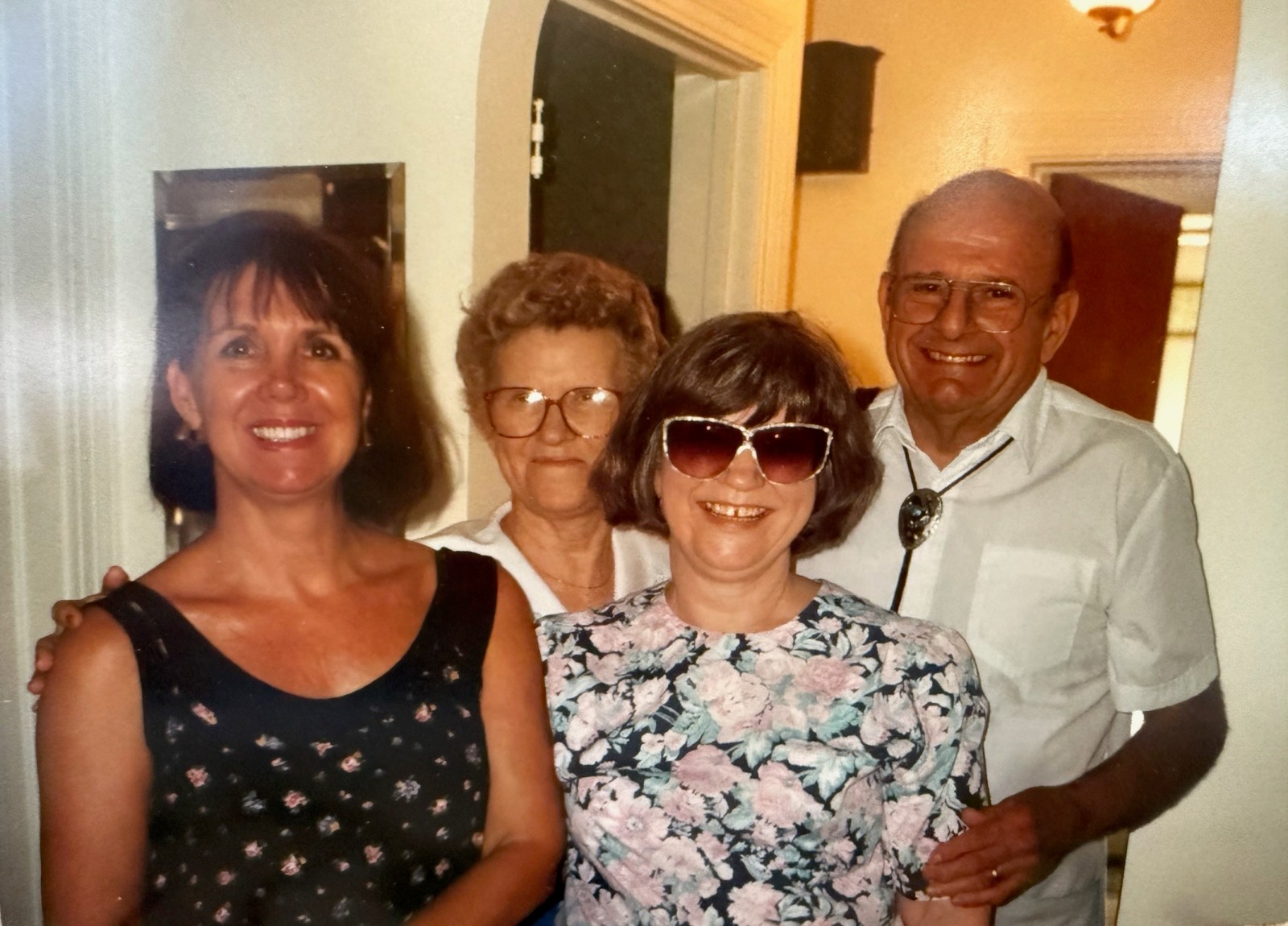
A few years after my father’s death, she met a wonderful man in her church—Gordon Rumble. They were married on Aug. 1, 1988. They stayed married until her death in 1995. During those years I never saw my mom happier. She loved my dad with all her heart and soul, but their marriage was weighted-down with hardship. She was more relaxed in her second marriage, a free spirit, able to be Inez Gallegly-Rumble, with nothing to do but just be herself.
And then THE STROKE.
GG was much more than I could remember and deserved a better account than my feeble attempt and limited mind could express. She was also a very complicated lady.
I have often wondered who or what she would have been in a different time and place.
 jackzilla land
reply